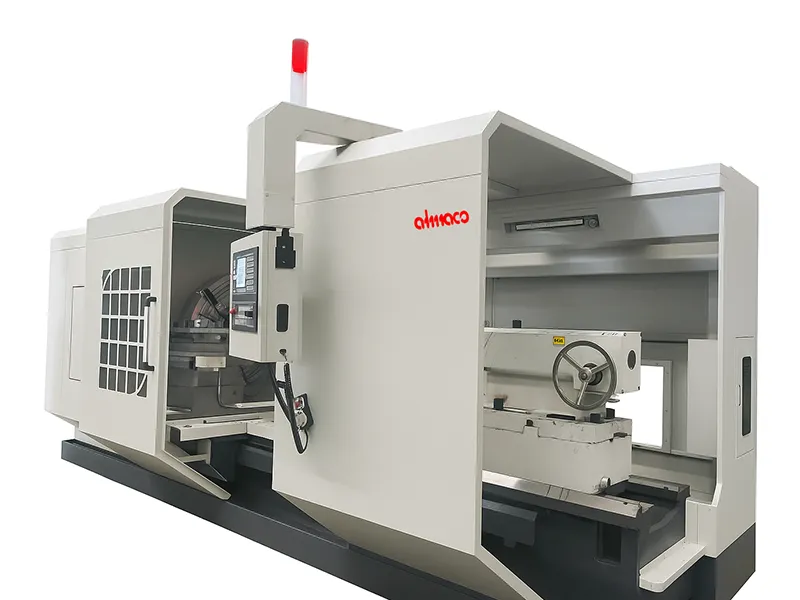
Grinding is a finishing process used to achieve the required dimensions, geometry and surface finish of a workpiece. The right CNC grinding machine type depends on the surfaces to be ground, the workpiece geometry, the required precision and the production volume.
A CNC grinding machine uses a rotating abrasive wheel controlled by a numerical control system to remove small amounts of material. CNC control manages machine movements and feed operations, supporting consistent results in precision manufacturing.
This guide introduces the main types of CNC grinding machines, their applications, advantages and limitations, and the key factors to consider when selecting equipment for your production requirements.
What Is a CNC Grinding Machine?
A CNC grinding machine removes material using a rotating abrasive wheel whose movement and feed are controlled by a computer numerical control system. Unlike turning and milling, which use defined cutting edges, grinding removes material through the action of abrasive grains distributed across the wheel surface.
This process is widely used when components require tight dimensional tolerances, controlled geometry or fine surface finishes, particularly after heat treatment or hardening.
Depending on the machine configuration, grinding can process flat surfaces, external diameters, internal bores, cutting-tool profiles and other specialized geometries. Common workpiece materials include hardened steel, tool steel, carbide, ceramics and glass. The appropriate wheel, grinding parameters and machine configuration depend on the material and the required result.
Quick Comparison: Which CNC Grinding Machine Do You Need?
| Machine Type | Main Application | Typical Workpieces |
| Surface Grinding Machine | Grinding flat surfaces and precision mating faces | Mould plates, steel plates, guideways |
| Double Column Surface Grinding Machine | Grinding large, wide and heavy flat components | Mould bases, machine beds, large steel plates |
| Cylindrical Grinding Machine | Grinding external and internal diameters | Shafts, spindles, rollers, sleeves |
| Centerless Grinding Machine | High-volume grinding of compatible cylindrical parts | Bars, pins, needle rollers, valve stems |
| Vertical Grinding Machine | Grinding large, heavy rotational components | Bearing rings, gear rings, flanges |
| Tool and Cutter Grinding Machine | Manufacturing and resharpening cutting tools | Drills, end mills, reamers, hobs |
| Crankshaft Grinding Machine | Grinding main journals and offset crankpin journals | Engine crankshafts |
These machine types are not all separate grinding processes. Some describe the grinding operation, while others refer to machine structure or specialized workpiece requirements. Understanding this distinction helps narrow down the most suitable configuration.
Main Types of CNC Grinding Machines
1. CNC Surface Grinding Machine
A CNC surface grinding machine is designed to produce flat surfaces, stepped faces and precision mating surfaces. It is widely used in mold manufacturing, toolmaking and general precision engineering.
Surface grinders can be classified by spindle orientation and worktable arrangement.
- Horizontal spindle surface grinder: The wheel axis is horizontal, and the workpiece passes beneath the wheel on a reciprocating table. This configuration is suitable for flat plates, mould plates and guide surfaces.
- Vertical spindle surface grinder: The wheel axis is vertical, allowing the wheel face to grind a larger surface area per pass. It is suitable for applications requiring efficient grinding of broad flat surfaces.
- Rotary table surface grinder: The workpiece is mounted on a rotating table, supporting continuous grinding operations for suitable circular components such as rings and discs.
Best suited for: Flat workpieces, precision mating faces, mould plates, steel plates and machine guideways.
Selection consideration: Check the required grinding area, workpiece dimensions, flatness tolerance and production volume when choosing the spindle and table configuration.

2. Double Column Surface Grinding Machine
A double column surface grinding machine is a specialized surface grinder designed for large workpieces and heavy-duty grinding applications.
Its gantry-type structure supports the cross rail and grinding head between two columns. This configuration provides structural rigidity and a wide working range, making it suitable for grinding large surfaces and components that exceed the practical capacity of a standard surface grinder.
Typical applications include mold making, machine tool manufacturing and heavy equipment production. Common workpieces include large moulds and mould bases, machine tool beds, guideways, steel plates and other large flat components.
Best suited for: Large mould bases, machine beds, guideways and wide flat components that require a larger working envelope.
Selection consideration: Evaluate the workpiece dimensions, weight, required travel, grinding allowance and accuracy requirements to determine whether a double column structure is necessary. For small workpieces, a standard surface grinder may be more practical and space-efficient.

3. CNC Cylindrical Grinding Machine
A CNC cylindrical grinding machine grinds the external or internal surfaces of rotational components. It is widely used to manufacture precision shafts, spindles, rollers and other parts that require controlled diameters and surface finishes.
Common configurations include:
- External cylindrical grinding: Grinds the outside diameter of shafts, spindles, rollers and similar rotational components.
- Internal cylindrical grinding: Grinds internal bores, sleeves and bearing seats.
- Universal cylindrical grinding: Combines external and internal grinding capabilities in one machine. Depending on the configuration, a swiveling wheel head can also support tapered-surface grinding.
Cylindrical grinding machines are used in general engineering, automotive manufacturing and other industries where dimensional accuracy and surface quality are important.
Best suited for: Precision shafts, rollers, sleeves, bushings and components requiring accurate external or internal diameters.
Selection consideration: Confirm the workpiece diameter and length, required roundness and surface finish, and the appropriate holding method, such as centers, a chuck or a collet. For high-volume production of compatible cylindrical parts, centerless grinding may offer a more efficient alternative.

4. CNC Crankshaft Grinding Machine
A CNC crankshaft grinding machine is a specialized external cylindrical grinder designed for crankshafts and similar components with eccentric journals.
Unlike a conventional shaft, a crankshaft has main journals along its centerline and crankpin journals offset from that centerline. Grinding these surfaces requires suitable workholding, positioning and support arrangements to maintain the required journal geometry.
Crankshaft grinding machines are used in automotive and diesel engine manufacturing, marine power equipment and construction machinery production.
Best suited for: Engine crankshafts and other specialized components requiring accurate main-journal and crankpin geometry.
Selection consideration: Confirm the crankshaft dimensions, journal positions, required throw geometry, workpiece support requirements and production volume. For general-purpose shaft grinding, a universal cylindrical grinder may offer greater flexibility.

5. CNC Centerless Grinding Machine
A CNC centerless grinding machine grinds cylindrical workpieces without holding them between centers or securing them in a conventional chuck.
The workpiece is supported between three main elements: a grinding wheel, a regulating wheel and a workrest blade. The grinding wheel removes material, while the regulating wheel controls the workpiece rotation and feed. This arrangement reduces the need for individual workpiece clamping and can support high-throughput production.
Three common centerless grinding methods are used for different part geometries.
- Through-feed grinding: The workpiece moves axially through the wheel gap. This method is suitable for straight cylindrical parts such as bars and pins.
- In-feed grinding: The workpiece remains in position while the grinding wheel moves radially into it. This method is suitable for parts with shoulders, heads or stepped diameters.
- End-feed grinding: The workpiece moves axially against a stop and is ground using a suitable regulating-wheel configuration. This method is used for certain short or tapered parts.
Centerless grinding is common in automotive, bearing, medical component and fastener manufacturing. Typical workpieces include bar stock, pins, needle rollers and valve stems.
Best suited for: High-volume production of cylindrical parts that can be supported and fed stably through the grinding zone.
Selection consideration: Check the part geometry, diameter range, length, feed method, dimensional requirements and production volume. Components that cannot be supported or fed stably may require another grinding process.

6. Vertical Grinding Machine
A vertical grinding machine uses a vertical spindle arrangement with the workpiece positioned on a horizontal table. This configuration is particularly suitable for large and heavy rotational components because the table supports the workpiece weight directly.
Depending on the machine design, vertical grinding can accommodate flat faces, end faces, and internal or external cylindrical surfaces. This can reduce the need to reposition certain large components between separate grinding operations.
Typical applications include wind power equipment, energy machinery, bearing manufacturing and heavy industrial equipment. Common workpieces include large bearing rings, gear rings, flanges and rotary tables.
Best suited for: Large, heavy rotational parts that require stable support during grinding.
Selection consideration: Evaluate the workpiece weight, table capacity, maximum diameter, required grinding surfaces and dimensional tolerances. For small shaft-type components, a conventional cylindrical grinder is generally more practical.
7. Tool and Cutter Grinding Machine
A tool and cutter grinding machine is designed to manufacture, regrind and restore cutting tools. It reproduces the required tool geometry and cutting-edge condition, helping maintain machining performance and reduce unnecessary tool replacement.
Typical workpieces include end mills, drills, reamers, hobs and other cutting tools used in tool manufacturing, mold processing and precision engineering.
Depending on the machine’s capabilities, different tool geometries may require specialized grinding wheels, fixtures, software and multi-axis control.
Best suited for: Cutting-tool manufacturing, tool resharpening and applications requiring precise cutting-edge geometry.
Selection consideration: Identify the tool types, diameter range, flute and profile geometry, required accuracy and whether the machine will be used mainly for new tool production, resharpening or both.
Comparison of Different CNC Grinding Machines
The following table compares common machine types by their applications, production suitability, main advantages and limitations.
| Machine Type | Main Grinding Task | Typical Production Suitability | Main Advantage | Main Limitation |
| Surface Grinder | Flat and stepped surfaces | Low to high, depending on setup | Flexible for precision flat-surface grinding | Not designed for long cylindrical surfaces |
| Double Column Surface Grinder | Large flat surfaces | Depends on part size and production requirements | Large working envelope and rigid structure | Requires more floor space and investment |
| Cylindrical Grinder | External and internal diameters | Single-piece to batch production | Flexible precision grinding for rotational parts | Requires suitable workholding and setup |
| Centerless Grinder | External cylindrical surfaces | High-volume production of compatible parts | High throughput without center or chuck setup | Part geometry must allow stable support and feed |
| Vertical Grinder | Faces and cylindrical surfaces on large rotational parts | Depends on component size and production requirements | Stable support for heavy workpieces | Usually less practical for small shaft-type parts |
| Tool and Cutter Grinder | Cutting-tool profiles and edges | Specialized production and regrinding | Handles dedicated cutting-tool geometries | Not intended for general flat or cylindrical components |
| Crankshaft Grinder | Main and eccentric journals | Engineered for the required crankshaft production volume | Specialized capability for crankshaft geometry | Limited flexibility for unrelated workpieces |
Production suitability is indicative rather than a fixed rule. Actual productivity depends on the part geometry, batch size, machine configuration, automation, setup time and process requirements.
How to Choose the Right CNC Grinding Machine
Selecting a grinding machine requires more than matching the machine name to the workpiece. The following factors help determine which configuration is practical for your application.
1. Identify the Surface and Geometry to Be Ground
Start by identifying the surfaces that require grinding.
- Flat surfaces and precision mating faces generally call for surface grinding.
- External and internal diameters on rotational parts generally call for cylindrical grinding.
- Compatible cylindrical parts produced in large quantities may benefit from centerless grinding.
- Large, heavy rotational components may require a vertical grinding configuration.
- Cutting tools require a tool and cutter grinding machine.
- Crankshafts with offset crankpin journals may require a dedicated crankshaft grinder.
If a component has several grinding surfaces, determine whether one machine can complete the required operations or whether multiple setups or machines are necessary.
2. Confirm Workpiece Dimensions and Weight
The maximum workpiece diameter, length, height and weight determine the required working envelope and support capacity.
For large flat components, check table dimensions, longitudinal travel and cross travel. For rotational parts, confirm the maximum grinding diameter, workpiece length and holding capacity.
Large mould bases and machine beds may require a double column surface grinder, while heavy rings and flanges may be better suited to a vertical grinder.
3. Define the Required Precision and Surface Finish
Review the drawing for dimensional tolerances, flatness, roundness, cylindricity and surface roughness requirements.
These requirements influence machine accuracy, grinding-wheel selection, dressing capability, process parameters and the need for in-process measurement or temperature control.
Evaluate the complete grinding process rather than relying only on the machine’s stated positioning accuracy. The achievable result also depends on the workpiece material, setup stability, wheel condition and process control.
4. Consider Material, Hardness and Stock Allowance
The workpiece material and hardness affect wheel selection, grinding parameters, cooling requirements and achievable productivity.
Also determine the amount of material to be removed. A larger stock allowance may require separate roughing and finishing operations, while a fine surface-finish target may require more controlled dressing and finishing parameters.
Provide the material grade, hardness, current dimensions and required finished dimensions when discussing a machine with a manufacturer.
5. Match the Machine to Production Volume
Production volume affects the balance between flexibility, setup time and throughput.
- Single pieces and small batches: A flexible machine may be preferable when workpiece types change frequently.
- Recurring batches: A machine with suitable CNC programs and repeatable setups can help maintain consistent results.
- High-volume production: Centerless grinding or a dedicated machine may reduce handling and cycle time for compatible components.
Annual output alone is not enough to determine the best machine. Part geometry, changeover frequency, cycle time and automation requirements must also be considered.
6. Evaluate Automation and Process Monitoring
Depending on the application, useful options may include automatic loading and unloading, in-process gauging, wheel-wear compensation and integration with an existing production line.
Automation can reduce manual handling and improve process consistency, but the appropriate configuration depends on the workpiece, production volume and required level of unattended operation.
7. Compare Total Processing Cost
Machine purchase price is only one part of the investment. Consider the overall cost of producing an acceptable finished component, including:
- Grinding wheels, dressing tools and other consumables
- Setup time and cycle time per workpiece
- Labor and material handling
- Coolant, maintenance and energy requirements
- Floor space and integration with existing equipment
- Inspection, rework and production downtime
A machine with a higher initial cost may be justified if it reduces processing time or handling costs. The decision should be based on the expected production requirements rather than machine price alone.
Common Mistakes When Selecting a CNC Grinding Machine
Avoid these common selection errors when comparing equipment.
- Choosing by workpiece name alone: A shaft, ring or plate may require different grinding methods depending on its geometry and the surfaces that need finishing.
- Confusing machine structure with grinding process: A double column grinder is a structural configuration of a surface grinding machine, not a separate grinding process.
- Focusing only on nominal machine accuracy: Wheel condition, dressing, workholding, coolant and temperature control also affect the finished part.
- Choosing centerless grinding without checking part suitability: The workpiece must be supported and fed stably through the grinding zone.
- Ignoring measurement and workholding: An unsuitable fixture or measurement strategy can compromise repeatability even when the machine itself is capable.
- Overlooking wheel dressing: Consistent wheel condition and profile are important for maintaining grinding performance.
- Ignoring thermal effects: Heat generated during grinding can affect dimensional accuracy and surface quality, making suitable cooling and process control important.
- Over-specifying machine precision: Purchasing capabilities beyond the actual drawing and production requirements can increase investment without delivering corresponding value.
Information to Prepare Before Selecting a CNC Grinding Machine
Providing complete technical information helps a machine manufacturer assess the application and recommend a suitable configuration.
| Information to Provide | Why It Matters |
| Workpiece drawing or technical diagram | Identifies geometry, grinding surfaces and required operations |
| Material grade and hardness | Influences wheel selection, grinding parameters and machine requirements |
| Maximum workpiece dimensions | Determines the required working envelope and machine capacity |
| Workpiece weight | Determines table, chuck, center and support requirements |
| Surfaces to be ground | Clarifies whether flat, external, internal, profile or specialized grinding is needed |
| Stock allowance | Helps establish material removal requirements and roughing/finishing strategy |
| Dimensional and geometric tolerances | Defines accuracy and measurement requirements |
| Surface roughness target | Influences wheel selection, dressing and finishing parameters |
| Batch size and annual production volume | Helps determine setup strategy, automation and production configuration |
| Automation requirements | Identifies loading, gauging and production-line integration needs |
If available, include sample parts, inspection requirements, expected cycle time and any existing process information. These details can help the manufacturer evaluate machine suitability more accurately.
Frequently Asked Questions About CNC Grinding Machines
What are the main types of CNC grinding machines?
ommon types include surface, cylindrical, centerless, vertical, and tool and cutter grinding machines. Specialized equipment, such as crankshaft grinders, is designed for specific workpiece geometries. The appropriate choice depends on the grinding operation, machine configuration and production requirements.
What is the difference between surface grinding and cylindrical grinding?
Surface grinding is mainly used for flat surfaces, stepped faces and precision mating surfaces. Cylindrical grinding is used to finish the external or internal diameters of rotational components, such as shafts, sleeves and rollers.
What is the difference between cylindrical and centerless grinding?
Cylindrical grinding typically holds the workpiece between centers or in a chuck or collet. Centerless grinding supports the workpiece between a grinding wheel, a regulating wheel and a workrest blade, eliminating the need for conventional center or chuck holding. Centerless grinding is particularly useful for high-volume production of compatible cylindrical parts.
When should I use a double column surface grinding machine?
A double column surface grinder is worth considering when the workpiece is too large or wide for a standard surface grinder, or when the application requires a rigid structure and a larger working envelope. Typical workpieces include large mould bases, machine beds and guideways.
When is a vertical grinding machine suitable?
A vertical grinder is suitable for large, heavy rotational components such as bearing rings, gear rings, flanges and rotary tables. Its horizontal worktable supports the workpiece weight directly, which can improve stability during grinding.
What parts are suitable for centerless grinding?
Typical examples include bar stock, pins, needle rollers and valve stems. The workpiece must have a geometry that allows stable support and controlled feeding between the grinding wheel, regulating wheel and workrest blade.
Can CNC grinding machines process hardened materials?
Yes. Grinding is commonly used for hardened steel and tool steel, and it can also process materials such as carbide, ceramics and glass with suitable equipment and abrasive systems. The correct machine, wheel and grinding parameters depend on the material and the required finish.
What affects CNC grinding accuracy and surface finish?
Important factors include machine condition and accuracy, grinding-wheel specification, wheel dressing, workholding stability, coolant delivery, temperature control and process parameters. Measurement and compensation systems may also be necessary for demanding applications.
How do I select the right CNC grinding machine for my application?
Start with the workpiece drawing and identify the surfaces and geometry to be ground. Then evaluate workpiece dimensions and weight, material and hardness, required tolerances, surface finish, production volume, automation needs and total processing cost. Sharing these details with a machine manufacturer can help narrow down the appropriate configuration.
Find the Right CNC Grinding Machine for Your Application
Choosing the right CNC grinding machine starts with understanding the workpiece, the surfaces that require finishing and the required production results. Surface, cylindrical, centerless, vertical and specialized grinding machines each serve different manufacturing needs.
Prepare your workpiece drawing, material specifications, dimensional tolerances, surface-finish requirements and expected production volume before comparing machine configurations. With these details, you can evaluate machine capacity and processing suitability more effectively and identify an option that fits your manufacturing requirements.